
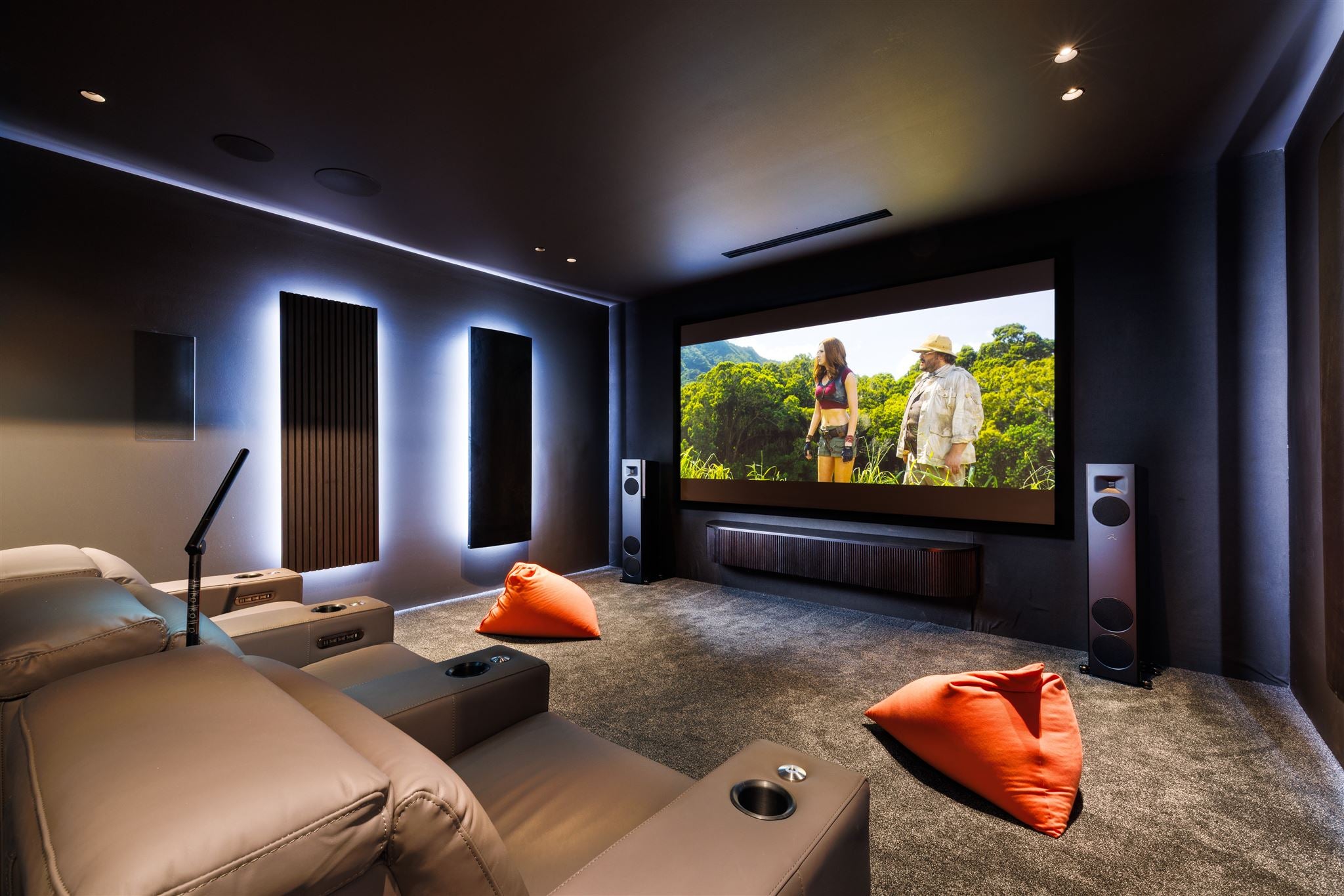

AV is increasingly part of the modern home, but it can be easy to overlook until the room is already designed.
Where should the speakers go? How much space does a projector need? Where does the equipment live? What needs to be planned before plaster goes in?
This guide covers the fundamentals worth considering when integrating AV into a residential project, so you can bring the right conversations into the project at the right time.
01. Start With The Brief
Before choosing equipment, understand how the room will actually be used.
A living room used for background music requires a very different approach from a dedicated home cinema.
Ask:
☐ What will the room primarily be used for?
☐ TV and streaming?
☐ Music?
☐ Movies and cinema?
☐ Gaming?
☐ Whole-home audio?
☐ Do you want the technology visible or concealed?
☐ Are there rooms to connect for whole-home audio?
☐ Should the system be operated from one place?
Tip: Ask these questions during the design phase, not when the electrician is already on site.
This sounds obvious, but speaker placement should be considered alongside the room layout. Furniture, windows, joinery, lighting and architectural features can all influence where speakers can realistically go.
Consider:
Walls
Can speakers be integrated into walls, joinery or cabinetry?
Ceilings
Could in-ceiling speakers provide better coverage while keeping walls clear?
Joinery
Is there an opportunity to conceal speakers within custom joinery?
Acoustics
Will hard surfaces, glass and open-plan spaces affect the sound?
Subwoofers
Where can low-frequency equipment be positioned without becoming visually intrusive?
02. Think About Speakers Before You Need To Think About Speakers.
Design Checklist:
☐ Speaker positions considered
☐ Furniture layout considered
☐ Ceiling plans coordinated
☐ Joinery coordinated
☐ Subwoofer locations considered
☐ Acoustic requirements discussed

03. Concealed Doesn't Mean An Afterthought
If the goal is for technology to disappear, the construction needs to accommodate it.
A speaker that needs to sit flush with a wall or ceiling needs to be planned into that surface.
The same applies to:
- Cable pathways
- Conduit
- Equipment racks
- Power
- Networking
- Projector locations
- Screens
-
Acoustic treatments

04. Don't Forget The Equipment
The speakers and screen might be the visible part of an AV system—or they might be completely hidden.
But somewhere, the equipment still needs to live.
AV equipment can include:
- AV receivers/processors
- Amplifiers
- Streaming devices
- Media servers
- Network equipment
- Power management
-
Control systems
05. Acoustics Are Part Of The Architecture
| Material | Potential Consideration |
|
Glass |
Strongly Reflective |
| Stone
|
Highly Reflective |
| Concrete | Highly Reflective |
| Timber | Can contribute to reflections |
| Curtains | Helps absorb sound |
| Rugs | Helps reduce reflections |
| Upholstery | Helps absorb sound |
This is one of the least glamorous parts of AV and one of the most important. Technology changes. The infrastructure behind it should give the system room to evolve.
Infrastructure checklist
☐ Power
☐ Data/network
☐ Speaker cable
☐ HDMI/data pathways
☐ Conduit
☐ Equipment rack location
☐ Access for maintenance
☐ Future upgrade pathways
The golden rule:
If you can, run conduit now, it's much harder to do it later.
06. Who Needs To Be In The Conversation?
Integrated AV works best when it's coordinated across the project team.
| Person | Potential Consideration |
| Architect | Defines the architectural intent and spatial planning. |
| Interior Designer | Coordinates finishes, furniture, lighting and visual integration. |
| Electrician | Coordinates power, cabling and infrastructure. |
| Builder | Coordinates construction and installation sequencing. |
| AV Integrator | Translates the entertainment requirements into the technology, specification and installation. |
| Client | Defines how they want to live, watch and listen. |

07. The Pre-Construction AV Checklist
Before construction begins, ask:
Client
☐ What does the client want to watch/listen to?
☐ Which rooms need AV?
☐ Do they want visible or concealed technology?
☐ Are there future requirements to consider?
Architecture
☐ Where are the screens?
☐ Where are the speakers?
☐ Where does the equipment live?
☐ Has acoustics been considered?
☐ Has lighting been coordinated with screens/projectors?
Electrical
☐ Power locations confirmed?
☐ Data locations confirmed?
☐ Speaker cabling confirmed?
☐ Conduit planned?
Construction
☐ Speaker/AV locations coordinated with structure?
☐ Access requirements understood?
☐ Equipment ventilation considered?
☐ Installation sequence agreed?

AV should be designed into the project, not added to it.
Need help with an AV project?
We're happy to collaborate with your project team. Bring us your plans, ask a question or drop into the showroom to explore what's possible.


