
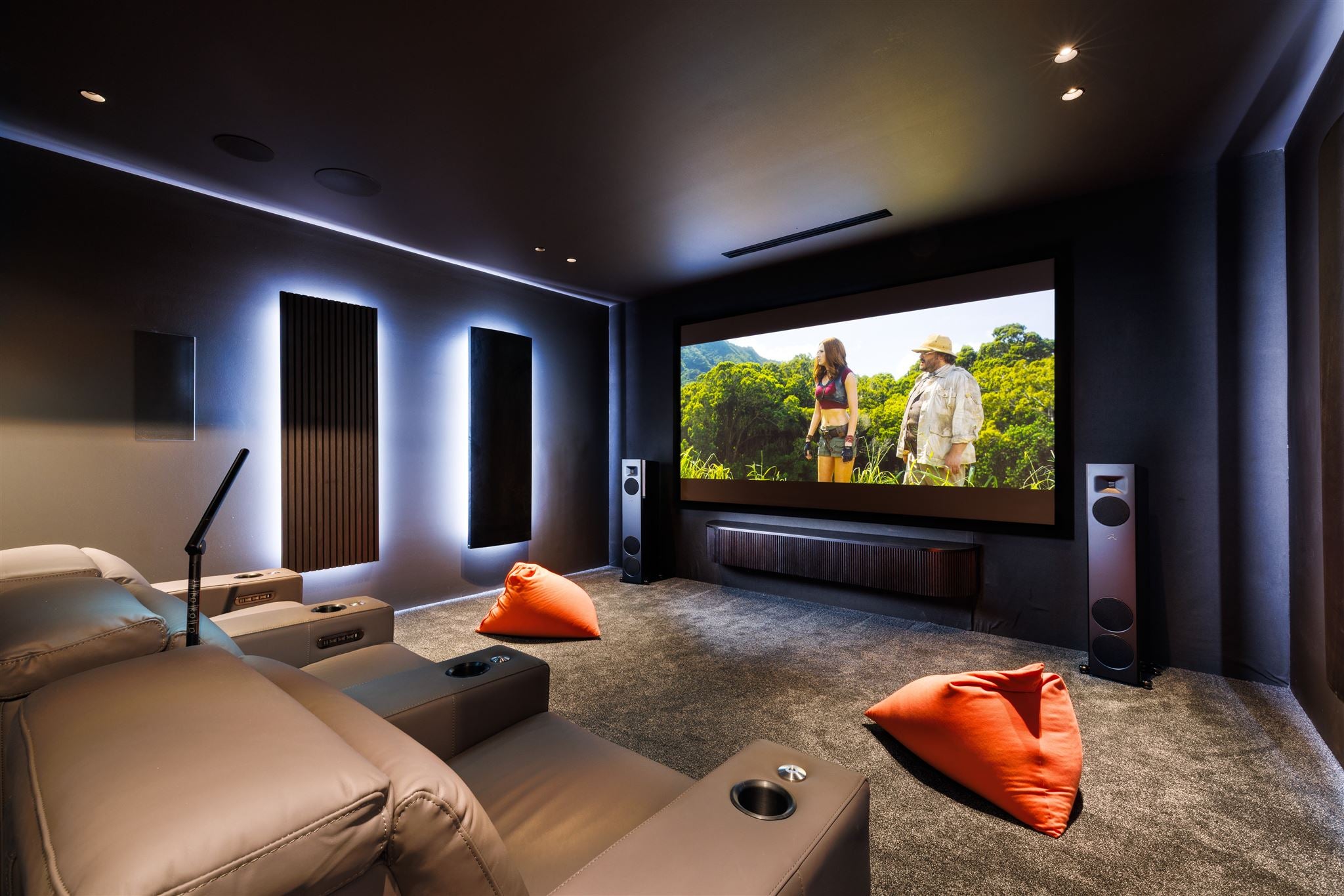

A home cinema that delivers a full-room experience comes down to the tech powering your space. It’s never about buying the most expensive gear, but choosing the right combination for your space, lifestyle, and how you actually watch.
This guide walks you through some key decisions, from display and speakers to acoustics and control, and why the brands you choose matter more than you might expect.
Key Insights: What Does a Great Home Theatre System Actually Need?
- The display you choose should match your room's light conditions and how you watch, not just how large you want the image to be.
- Speakers are where most systems live or die; what you hear has as much impact as what you see.
- An AV receiver or processor is the engine of the whole system; its quality determines how well everything else performs.
- Acoustic treatment is the invisible variable that separates a good cinema from a truly great one.
- The best home cinema setups are designed as complete systems, not assembled from unrelated parts.
Projectors & TVs for Your Setup
The projector versus TV question is the one most people start with. The answer depends far more on your room than on any specification sheet.
Projectors
Made for spaces where you can control the light. A Sony 4K projector throwing a 120-inch image in a properly darkened room creates an experience that no television can replicate, allowing you to feel the real scale of the film. Native 4K imaging for depth, laser light sources with 20,000-hour lifespans, next-level colour accuracy, and black-level performance, this range is hard to argue against.
TVs

For multipurpose or living rooms, TVs are usually the go-to choice. Our modern Sony BRAVIA range (available across screen sizes from 55 to 98 inches) handles ambient light with ease, ready to go the moment you sit down and integrate naturally into everyday life. When a space goes from a lounge room to the dedicated spot for movie nights, a large-format television offers that sweet spot.
Acoustics play a part too. A TV’s centre channel speaker typically sits directly below or above the screen. But a projector setup allows for it to be placed behind the screen, creating a more immersive experience.
Speakers: The Heart of Every Home Theatre System
If there's one component worth investing in seriously, it's speakers. The display shows you the film; the speakers make you believe it. Here are our recommendations:
Paradigm
Paradigm speakers are a benchmark in the world of custom home cinema for a reason. Paradigm designs and manufactures its own drivers in-house, resulting in speaker systems with excellent coherence and consistency. Their speaker ranges span everything from in-ceiling and in-wall options for architectural installations to powerful floorstanding models for dedicated rooms. The brand's focus on accurate, high-output sound reproduction across all frequencies makes them particularly well-suited to surround formats like Dolby Atmos and DTS:X, where the system needs to perform equally well regardless of the direction the sound is coming from.
Martin Logan
The Motion Martin Logan speakers use Folded Motion tweeter technology (a pleated diaphragm that moves air with exceptional precision and remarkably low distortion), delivering high-frequency performance with an open, airy quality. This is particularly noticeable in orchestral soundtracks, atmospheric film scores, and the fine details in dialogue.
When choosing speakers for a home cinema setup, the configuration matters as much as the brand. A 5.1 system (five speakers plus a subwoofer) is a solid foundation. A 7.1.4 Dolby Atmos layout with height channels crafts a more three-dimensional sound. The right configuration depends on your room size, ceiling height, and the audio experience you’re seeking.
AV Receivers & Processors
The AV receiver is the component most people underestimate. It routes every signal in your home cinema (both audio and video) and amplifies your speakers, determining how well the whole system performs in your space. Choosing the wrong one limits everything connected to it.
Anthem AV receivers are respected in the custom install world for a reason that goes beyond raw specification: ARC Genesis. Anthem Room Correction is a calibration system built into every Anthem receiver that uses a precision microphone and advanced algorithms to analyse and correct your room's acoustic behaviour.

This matters because your room is, effectively, the final component in your home cinema system. Walls, ceilings, furniture, and flooring all interact with sound in ways that can blur imaging, muddy bass, and make an expensive system sound disappointing. ARC Genesis addresses that with four storable profiles so you can choose the best one for different listening scenarios.
Anthem's MRX range varies from a capable 5-channel entry-level model to the 11-channel MRX 1140, with every model sharing the same core engineering philosophy. These are receivers built to audiophile-grade standards in a home cinema format.
We also carry AV receivers from Sony, JBL, NAD, and Storm Audio. Browse our range to find the right channel count and power output for your setup.
For larger or more complex installations, a separate processor and amplifier setup is worth considering. An AV processor handles all signal decoding and room correction without built-in amplification, which means you can pair it with dedicated power amplifiers sized precisely to your speaker configuration. The result is typically cleaner amplification, greater headroom, and a more flexible upgrade path. It's the architecture most commonly found in high-end custom installs and dedicated cinema rooms, where performance and scalability matter more than simplicity.
Why Brand Matters More in Premium Home Cinema
The brands worth considering for a premium home theatre system share some things in common:
- In-House Engineering: Brands like Paradigm design their own drivers; Sony developed SXRD technology from professional cinema tools.
- Consistent Voicing: Within a brand's range, speakers are tuned to match each other. A Paradigm in-ceiling should seamlessly blend with a Paradigm floor-stander.
- Long-Term Firmware & Software Support: Anthem, for instance, has delivered significant performance improvements through firmware updates on existing hardware.
- Integration Advantage: Brands within the same ownership group (Anthem, Paradigm, Martin Logan) actively share calibration tools and acoustic data, making cross-brand integration genuinely better than chance.
That engineering depth is what makes the difference between a system that impresses on the first listen and one that you're still genuinely enjoying years later.
Room Acoustics: The Variable That Changes Everything
The unsung hero of any custom home cinema is the room itself. You can install exceptional equipment and still get muddy dialogue, boomy bass, and a diffuse soundstage if the acoustics aren't addressed.
At least 50% of the sound you hear in a room is reflected from the walls. The goal of acoustic treatment is to reduce that reflection delay time to between 0.2 and 0.4 seconds, depending on the room's size.
The key treatments are:
- Absorption Panels: Reduce reflections and reverberations for a cleaner sound.
- Bass Traps: Control low-frequency buildup, typically in corners.
- Diffusers: Scatter sound waves at the rear of the room to preserve liveliness.
There's also an important distinction between acoustic treatment and soundproofing. Treatment manages how sound behaves inside the room, while soundproofing prevents sound from travelling in or out. Both are worth addressing during a build or renovation, but they're different problems with different solutions.
Design a Complete System
The most common mistake in building a home cinema is choosing components in isolation. A flagship projector paired with modest speakers will disappoint. Beautifully specified speakers driven by an underpowered receiver will underperform. A well-matched system will almost always outperform a collection of individually impressive parts that were never designed to share a room.
That's the conversation we start with at Amplify AV. What's your room like? How do you watch? What does the space need to do beyond cinema nights? The answers shape every recommendation that follows.
If you're designing a home cinema setup or looking to make sense of an existing system that isn't performing the way it should, we'd love to help you think it through. Visit our Melbourne showroom to hear what a properly designed system actually sounds like or get in touch to start the conversation.


